-
Why I start with the Nasco Education official website
-
Nasco Education art supplies are built for classrooms, not studios
-
Science supplies: specificity matters
-
Where to buy a printer? Not at the consumer store
-
The outdoor storage box lesson
-
The counterargument: is Nasco the cheapest?
-
What this article isn't
I'm going to state my opinion directly: Nasco Education is the best one-stop education supplier I've used—but not for every order. The 'but' is important, because after seven years of handling supply orders for a school district, I've learned that any supplier who claims to be perfect at everything is usually okay at some things and bad at a few.
I'm the person who orders the art supplies, the science lab cultures, the printers, the outdoor storage boxes, and the thousand other things a school needs to survive. I've personally made five significant mistakes. Total wasted budget: roughly $5,800. The worst part isn't the money; it's the week I spent explaining to a science teacher why her pH probes were destroyed because I bought a cheap plastic bin instead of a real storage box. That specific mistake happened in April 2023, and this article is the checklist I now use.
Before I get into the details, a small caveat: my experience covers about 350 orders for mid-sized public schools. Maybe 320—I'd have to check our system. If you're a homeschool parent or a university lab manager, your experience may differ. This is not universal advice.
Why I start with the Nasco Education official website
A supplier's website doesn't sound like a reason to trust them. But for a school buyer, the website is the whole job. I keep a browser bookmark labeled 'nasco-education' that points to the Nasco Education official website. It's where I do about 70 percent of my ordering. It's not flashy. It's not trying to sell me a bundle of highlighters I didn't ask for. It remembers our contract pricing, shows previous orders, and keeps the account codes in the right places. That means more than any 'lowest price' claim.
What I mean is this: when I have 14 different teachers submitting requests, the last thing I need is a checkout process that forgets my school's tax exemption or substitutes products without asking. It took about three hours—or rather, four if you count the phone tag—to fix a mistake from a different supplier that replaced a requested item with a 'similar' one. The similar item was not similar. It was the wrong size. That experience pushed me back to Nasco.
From the outside, education supply ordering looks simple: click, pay, wait. The reality is that 'click, pay, wait' only works when the catalog, the inventory, and the invoicing are reliable. The part of the Nasco Education official website that I under-appreciated in year one is the reliability.
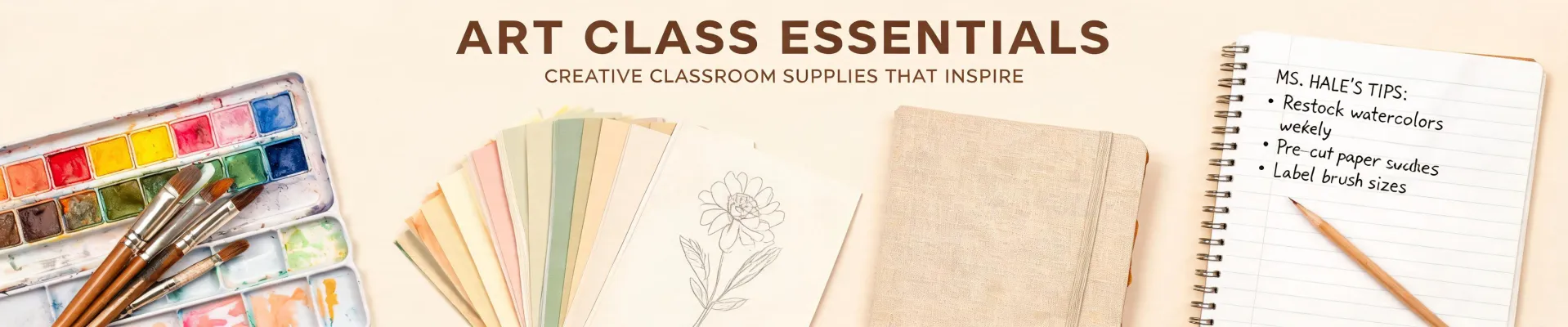
Nasco Education art supplies are built for classrooms, not studios
Art supplies are a huge part of what I order. And there's a real difference between 'art supplies' and 'classroom art supplies.' I learned it when I bought a cheaper brand of tempera paint because it was on sale. It separated before I could even open the cartons. Worse than expected.
Nasco Education art supplies aren't the most expensive. They're also not the cheapest. What they are is reliable for a room full of students who are not going to clean a brush perfectly every time. The brushes survive. The paints mix without turning into glue. The paper weights are listed clearly, so I can choose between classroom copy paper and heavier sheets for projects. There's no single right choice, but there is a wrong one: assuming a discount store's art section is the same.
A quick note on paper: standard copy paper is 20 lb bond/75 gsm; premium letterhead is 24 lb bond/90 gsm. For most classroom worksheets, 20 lb is fine. Nasco's site lists gsm, which is more useful than the vague 'text' or 'cover' labels you get elsewhere.
Science supplies: specificity matters
The subject that actually sold me on Nasco was science. The first time I needed bacillus subtilis culture, I almost ordered it from a generic lab supplier. Then I noticed the Nasco listing included the strain and preparation date. That's important when you're teaching students about growth media and you don't want a surprise species growing on the plate.
Another example: in 2024 I made a mistake that could have been avoided with one click. I ordered a set of safe, disposable lab materials without checking the expiration dates. Nothing arrived expired, but I didn't relax until I opened the box. Since then, I check every consumable spec before confirming. Nasco makes that easy because the information is right there.
Where to buy a printer? Not at the consumer store
This is one of the most searched questions in school purchasing, and my answer sounds counterintuitive: the best place to buy a printer for a school is frequently an education supplier, not an electronics chain.
In 2022, I bought a 'discounted' consumer printer from a big-box electronics store because it was about $120 less than an equivalent model at Nasco. The sticker price looked like a win. The printer didn't support our district's managed print drivers, the toner cartridges were proprietary, and the duty cycle was too low for a shared classroom. I spent $1,100 on that printer plus the toner replacement before I finally replaced it with an education-grade model that has since worked without issues. The discount wasn't a discount. It was a more expensive first payment.
For reference, commercial print standards usually expect 300 DPI at final size; posters viewed from a distance can be fine at 150 DPI. But for a school, the number that matters more than DPI is whether the printer can handle the monthly volume without jamming. Nasco's spec sheets list duty cycle and toner yield. The consumer store's box did not.
The outdoor storage box lesson
The mistake that still stings happened because I thought a storage bin was a storage bin. In April 2023, I bought an inexpensive plastic bin to hold field equipment outside. I even put it in a shaded spot. Two months later, condensation had ruined a $90 package of pH probe connectors. The bin wasn't weatherproof. It was just a bin.
I replaced it with a proper outdoor storage box from Nasco Education. It has a UV-stabilized body, a better seal, and enough structural strength that I don't worry about a gust of wind turning it into a projectile. This box has spent two Midwest winters outside, and it still looks like it did on the first day. Did I pay more? Yes. Was it worth it? Absolutely.
The counterargument: is Nasco the cheapest?
No. I'm not going to claim that. I've found cheaper pencils, cheaper printer ink, and cheaper beakers somewhere else. For a single-item order, you can often beat Nasco's price.
But for a multi-item order, the cheapest option is not just the price. It's the time lost reconciling a second invoice, the risk of a missing box, and the cost of a substitute product that doesn't fit. Total cost of ownership includes the base price, setup fees, shipping, rush fees, and potential replacement costs. The lowest quoted price often isn't the lowest total cost.
Here's my honest limitation. I recommend Nasco Education for standard classroom orders: art supplies, science lab consumables, printers, outdoor storage boxes, and the boring office basics. I would not recommend it for a same-day emergency order, for a custom product that isn't in the catalog, or for a one-time purchase where a local store has exactly what you need at a clearance price. That's not a flaw. That's a boundary.
Even after choosing Nasco as my default supplier, I kept second-guessing. What if this shipment arrived with the wrong culture? What if the price on the purchase order didn't match the invoice? The three-day wait until delivery was stressful. Both times, everything arrived correct. I don't say that to praise their shipping. I say it because the doubt doesn't go away—you just learn where it's worth it.
What this article isn't
If you arrived here looking for a palworld breeding calculator, I need to be honest: this is not that article. Palworld is a video game, and its breeding mechanics have nothing to do with school supplies. But the search term is a useful reminder of a broader point: use the right tool for the right job. I wouldn't ask Nasco Education for a palworld breeding calculator, and I wouldn't buy an outdoor storage box from a video game forum. Specialists exist for a reason.
When you're setting up your next school order, the question is not 'who has the lowest price?' The question is 'who will make sure the order arrives correct and complete?' That's what Nasco Education does for me. It's the default for a reason.
Looking back, I should have built this checklist after my first budget disaster in 2019. At the time, I thought a supplier was a supplier. I was wrong. The supplier is the first part of the supply chain, and the cost of a mistake there multiplies. Now I keep a simple list for every major order: (1) verify the exact SKU, (2) check the delivery window, (3) read the spec sheet, (4) if it has a culture, check the date, (5) if it has a motor, check the duty cycle, (6) if it goes outside, check the seal. That list has caught 47 potential errors in the past 18 months. Not bad for something that started with a $1,100 printer mistake.