-
1. What exactly is nasco-education?
-
2. What is the bacillus subtilis culture from Nasco Education?
-
3. What's different about Nasco Education art supplies?
-
4. What is a mulch calculator, and why does Nasco care?
-
5. What is a CPM calculator?
-
6. Where should you apply highlighter when studying?
-
7. What's changed in the education supply industry since 2020?
I'm a quality compliance manager at Nasco, which means I'm the last set of eyes on the education supplies before they ship. Over four years, I've reviewed thousands of products — art paints, lab cultures, calculators, microscope slides, the whole catalog — and I've rejected more first deliveries than I care to remember. Here are seven questions I actually hear from schools and labs, answered straight.
1. What exactly is nasco-education?
Nasco Education is the school- and lab-focused side of Nasco. It's meant to be a one-stop supplier: a biology teacher can order a bacillus subtilis culture for a lab, and the same purchase order can include drawing paper for the art room and a class set of calculators for algebra. One vendor, one truck, one invoice.
I came from a procurement background, so I get the skepticism. The first time I ordered from a catalog like this, I expected a messy pile of unrelated boxes. It wasn't. Everything matched the specs. We're not the cheapest line item on every single product — I'm not going to pretend we are — but the total cost of an order usually is lower when you're not paying five shipping fees and chasing five customer-service queues. That's what nasco-education is supposed to mean: one reliable source for the stuff schools use daily.
2. What is the bacillus subtilis culture from Nasco Education?
Bacillus subtilis is a Gram-positive, rod-shaped bacterium found naturally in soil and the human gut. It isn't pathogenic, so it's one of the safest organisms for classroom microbiology. Students can grow it on nutrient agar, observe colony morphology, practice aseptic technique, or test antibiotic sensitivity without the safety headaches of nastier species. Its endospores make it heat-resistant, which also helps it survive shipping.
We do verify culture viability before orders leave. In Q1 2024, we had a supplier running late, and I had about 48 hours to check a batch of cultures before schools' spring orders shipped. Normally I'd run a full growth protocol, but there was no time — I had to rely on visual inspection, transport logs, and the vendor's own documentation. I hated making that call. It worked out, but we rewrote the culture supplier contract afterwards so it doesn't happen again.
For first-time buyers: a freeze-dried (lyophilized) culture is usually easier to store and ship than a liquid one.
3. What's different about Nasco Education art supplies?
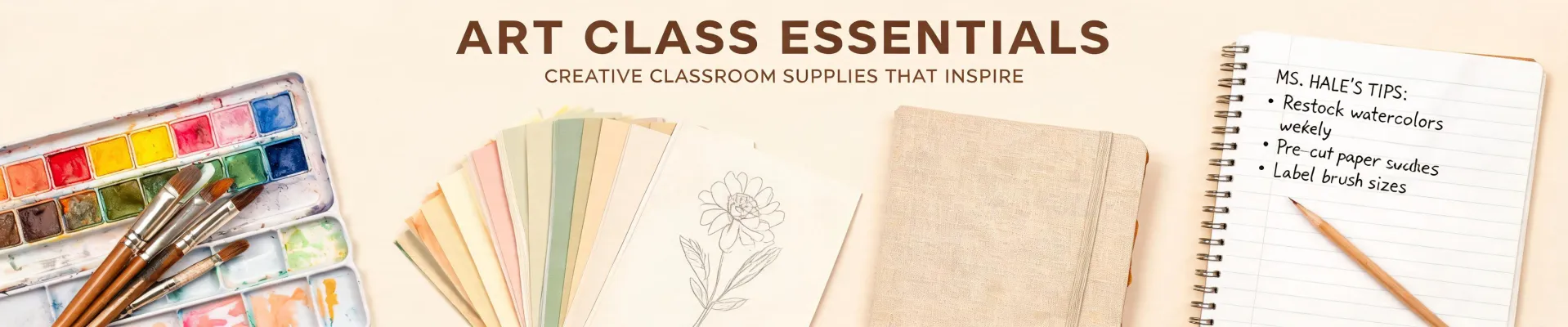
Classroom art supplies aren't hobby supplies. A student might go through a bottle of acrylic paint in two weeks, so the paint needs to be consistent, reorderable, and affordable in class packs. We check pigment lots for consistency because the color on the label has to match the color out of the bottle — and match what you ordered last semester.
Color matching is a rabbit hole. The industry standard tolerance is Delta E under 2 for brand-critical colors; 2–4 becomes noticeable to trained observers, and above 4 is visible to basically everyone. That's a Pantone standard, and it matters even in the art room, especially when students are mixing to a specific swatch or printing color projects.
There are times a local art store is easier — if you need three brushes today, go local. But for recurring classroom volume, ordering from a dedicated education supplier saves a ton of running around. We also offer discount codes on class packs, which schools remember when budgeting.
4. What is a mulch calculator, and why does Nasco care?
Every spring this becomes a hot search. A mulch calculator isn't a product — it's just a way to estimate how much mulch you need for a school garden, flower bed, or grounds project. Horticulture teachers and agriculture programs ask us about it constantly because we sell greenhouse and soil supplies.
The math: multiply length by width to get the area, multiply by the depth in feet, then divide by 27 to get cubic yards. Example: a 10 ft × 20 ft bed at 3 inches deep. 10 × 20 = 200 square feet. 3 inches = 0.25 ft. 200 × 0.25 = 50 cubic feet. 50 ÷ 27 = 1.85 cubic yards. So order about 2 yards. If you're buying 2-cubic-foot bags, one bag is 0.074 cubic yards, so 2 yards ≈ 27 bags. Round up a little — mulch settles.
Some schools turn this into a math lesson: real-life volume problems, basically free when there's a grounds project to plan. That's a win-win in my book.
5. What is a CPM calculator?
Honest answer: it depends on who's asking, because CPM has two common meanings — and I've had to look them up more than once myself.
In business and marketing classes, CPM stands for cost per mille — the cost per thousand ad impressions. The formula is CPM = (total cost ÷ impressions) × 1,000. Example: a $50 campaign gets 25,000 impressions. ($50 ÷ 25,000) × 1,000 = $2.00 CPM. Marketing teachers use this alongside the basic calculators we sell.
In science labs, CPM means counts per minute — a radiation measurement, usually from a Geiger counter. You subtract the background count from the sample count to get net activity. It shows up in physics and environmental science classes more than you'd expect.
So when someone searches "cpm calculator," the right tool depends on whether they're in a business classroom or a lab. We sell calculators for both — scientific ones for the lab, standard ones for the marketing math.
6. Where should you apply highlighter when studying?
I know "where to apply highlighter" is also a makeup question — but we're an education supply company, so let's talk about the pen version. Highlighting works when it's selective and almost always fails when it isn't.
Apply highlighter to:
- Topic sentences and thesis statements
- Key terms and their definitions
- Dates, formulas, and classifications
- Anything the teacher says twice
Not whole paragraphs. Highlighting an entire page kinda defeats the point — you've just made a wall of neon. A color-coding system helps: yellow for definitions, blue for examples, pink for exam-worthy facts. And highlight after reading a section once, not during the first pass. That forces you to decide what matters.
One more thing: heavy highlighters bleed through cheap paper. Standard 20 lb copy paper (about 75 gsm) will show it; 24 lb / 90 gsm handles it way better, and it survives erasing too. We carry both — the heavier weight is worth it for anything students keep.
7. What's changed in the education supply industry since 2020?
What was best practice in 2020 may not apply in 2025. The shift wasn't one policy or one product — it's the way schools buy. Districts that mailed paper purchase orders switched to online ordering; they want to see specs, check availability, and check out without a phone call. That transformation is why nasco-education exists as a digital storefront instead of just a printed catalog.
The fundamentals haven't changed — quality, accurate specs, and delivery you can count on. The execution has.
Science supplies ship in safer packaging. Art supplies have better shelf-life info. The supply chain is more transparent about where products come from and when they'll arrive. If you're still sourcing like it's 2019, this is your nudge to look at what changed.
There's something satisfying about a school order that lands complete: art supplies in one box, lab cultures in another, every line item checked and documented. After a bad shipment, a good one is its own reward. That part, I hope, never changes.