I have a confession: I used to think a purchase order was good if the bottom line was low. Not anymore. After eight years handling education supply orders for our district, and after roughly $18,000 in documented mistakes, I can say it plainly: the lowest quote is rarely the cheapest order.
In my first year (2017), I made the classic error. I split a large education supplies order into categories and assigned each line to the lowest bidder. By spring, eleven of those products had failed or needed a replacement. Everything I'd read said competitive bidding saves money. In practice, I found that saving 4 percent on a product that doesn't work costs more than paying 8 percent more for one that does. I never expected to become the person who defends higher line items. Turns out that's exactly what a procurement budget needs.
The Binder Lesson
Start with something as ordinary as a binder. Search 'what is a binder' and you'll see a ring binder, the kind with a fabric cover and three metal rings. That's what we ordered in September 2022: 800 binders at $1.12 each from a discount supplier, instead of $1.48 each from our usual education vendor. We saved $288. On paper, a win.
The binders arrived on time. The colors matched. Then, within two weeks, teachers started reporting torn pages. The back rings weren't aligning properly, so the binder teeth caught the paper. Not ideal. Actually, not acceptable. We spent the next two weeks replacing them room by room. When we counted the supply clerk's labor, the phone calls to the vendor, and the substitute coverage for one teacher who spent a planning period fixing her class set, that $288 savings turned into a $1,450 problem. (This was a small order, too; I still wince when I think about what would happen on a district-wide buy.)
At this point, you might wonder why we didn't just process a return and move on. Fair question. The hidden cost wasn't the product itself; it was the process. We had to request a return authorization, take photos, make a phone call, wait for a credit note, then re-enter an order into the purchasing system. That process took most of a week. Nobody adds that staff time to a bid comparison.
A binder is a simple product, but not all binders are equal. What I mean is that unit price ignores the cost of a lesson interrupted, a homework sheet ruined, and a procurement officer's inbox full of complaints. None of those costs appear on the vendor's quote. The conventional wisdom says that a binder is a binder. My experience says the rings, the hinge, and the board density all matter — especially for eighth graders.
The Search Terms That Taught Me About Specifics
Specialized supplies are where the same problem gets worse. One year, the math department requested a 'mean calculator'. I almost ordered basic four-function calculators because I searched 'calculator', sorted by price, and found the cheapest one. The teacher gently explained that she wanted a calculator with one-variable statistics functions, so students could compute the mean quickly and spend more time interpreting the number rather than punching buttons. The $3.20 version was not a bargain. The $8.10 version did exactly what the class needed. We bought twenty, and that line item worked flawlessly for the rest of the year.
A similar moment happened in 2023 when our nursing instructor asked for a 'creatinine clearance calculator'. If you don't work in health education, it sounds like a physical calculator with buttons. But the instructor meant a clinical formula tool (the Cockcroft-Gault equation) that calculates creatinine clearance from a patient's lab values. The cheapest office supplier would have sent a pocket calculator, and it would have been useless for the assignment. What was the hidden cost there? A failed lesson, a confused instructor, and a return process that lasted longer than the budget cycle.
Lab supplies hit me the same way. In October 2021, I bought Bacillus subtilis culture from a low-priced vendor because the catalog line looked identical. The culture arrived, but without the safety documentation our biology teacher needed. We had to expedite a replacement (this was back in 2021, when shipping was still unpredictable) and the 'savings' turned into a 1-week delay and $190 in extra shipping. That single mistake changed how I search for science lab materials: now I search for the product, the safety sheet, and the supplier's category experience, not just the unit price.
Searching for 'what is a binder' may seem unrelated, but it's actually a useful reminder. When someone has to search for a definition, they're really asking for context: what type of binder, what type of calculator, what type of culture? If the supplier's catalog doesn't help you answer that, the lowest price is a trap.
Art Supplies, Coupon Codes, and the One-Stop Reality
Art supplies are where I stopped trusting the spreadsheet. In 2019, I bought cheap acrylic paint for the K-8 art program. We saved $0.40 per bottle, which looked great in the PO. Then the art teacher told me the pigment separated in the bottle, the paint went on streaky, and the class set had to be finished with supplies from her own closet. The surprise wasn't the price difference. It was how much classroom frustration came packaged with the savings.
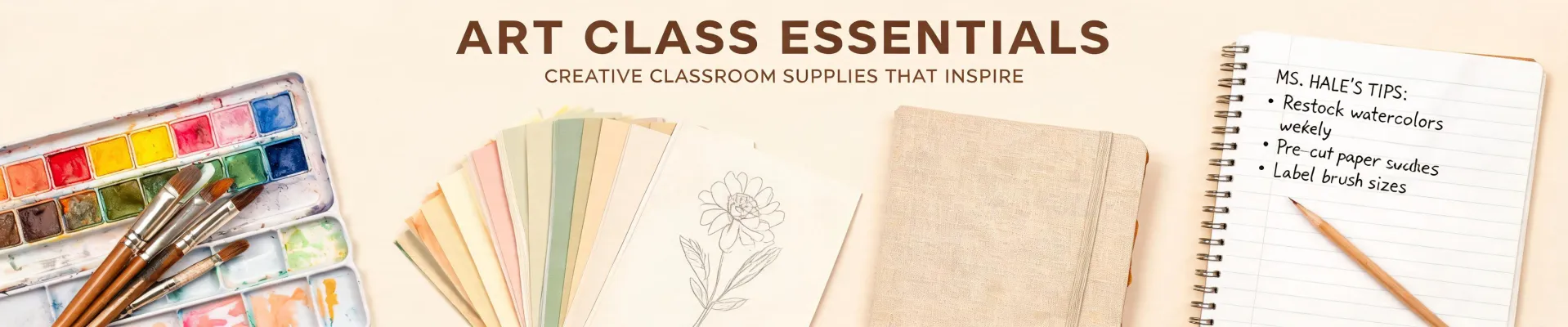
Since then, our school has moved most nasco education art supplies onto one standing order. Not because Nasco Education is always the lowest bidder, but because the products are consistent. The brushes don't shed on the first day, the paint colors actually match the labels, and the paper doesn't tear when it's wet. That consistency is what I mean by a one-stop education supplier. Binders, calculators, printers, art materials, science cultures, office equipment — when the vendor understands the classroom, the total cost of ownership goes down.
Printers are another example. Our school bought a low-priced printer for the front office because the maintenance contract on the old one was expiring. The unit was cheap, but the toner cartridges cost almost as much as the printer and lasted about two weeks. That 'best office supply deal' became one of the most expensive machines we've ever installed. Now I check consumable costs before I buy any hardware.
And yes, I still use nasco education coupon codes. I search for them before every major order. A coupon code is a smart way to reduce the price of a product that already meets the requirement. But a discount code is not a substitute for knowing what you're actually buying. I've learned that the hard way, and I have the spreadsheet notes to prove it.
Reasonable People Will Say 'But Budgets Are Tight'
I know the objection: in education procurement, budgets are tight, so the lowest quote should win. I used to agree. Then I counted my own mistakes: over eight years, I've documented 23 significant ordering errors that cost roughly $18,000. Most of those were not caused by an expensive supplier. They were caused by buying a cheap version of the wrong specification. Since I created a pre-order checklist in early 2024, we've caught 47 potential errors — including two orders that would have delayed science labs by several weeks. That checklist doesn't say 'buy the most expensive option'. It says 'confirm the spec, the intended use, and the delivery promise before comparing prices'.
If your procurement policy requires three quotes and the lowest bid, the answer is not to break the rule. The answer is to define the product narrowly enough that the lowest bid is for exactly what the classroom needs. A binder with the right rings, a calculator with the right function, a culture with the right paperwork, an art supply that won't ruin a project.
The lowest price is only one line of the story. Shipping comes next. Then return handling. Then replacement processing. Then the hour the teacher spends explaining why the product doesn't work. Add those up and the 'cheap' supplier often isn't cheap at all.
This is not an argument for ignoring price. A buyer who ignores price is just as irresponsible as one who worships it. The argument is to use value instead of sticker shock. Evaluate the product, the application, the delivery date, and the reliability of the supplier. Then use coupons, discounts, and negotiated pricing to make the right product more affordable.
The Bottom Line
As of January 2025 (and I don't expect this to change), I still compare prices on every purchase. But I also ask one simple question before approving: what will this order cost if the item doesn't work? The real bargain is the product that does its job the first time, from a supplier who can back it up, at a price that fits the budget — not the line that looks cheapest in the quote. That may sound like a defense of paying more. It isn't. It's a defense of knowing the difference between price and cost. And after eight years, I'm comfortable defending that opinion at any budget meeting.